- About Us

- Products
- Services
- Investor Relations
- News & CSR
- Blog
- Sustainability
- Distributors
- Contact Us
- Notice / Finance Policy
- Privacy Notice
- e-Billing System
- Intranet

Core Values


TEAMWORK
We collaborate to achieve common goals, with clear roles and shared accountability. This teamwork fosters a structured environment that promotes collective success.

RESPONSIBILITY
We are committed to our responsibilities toward stakeholders across all dimensions—economic, social, and environmental. We work with diligence and ensure timely delivery of our projects.

INTEGRITY
We promote trust, respect, and integrity in the workplace, avoiding deceit and dishonesty. Everyone must be honest with themselves and others, making decisions based on the organization's collective interests.

INNOVATION
We engage in continuous learning and development, utilizing creativity to generate benefits and create value.

PERFORMANCE
We create quality work and develop skilled individuals, delivering results efficiently and in alignment with stakeholder expectations. We continuously strive to improve and innovate.

SPEED
We encourage proactive work that focuses on critical thinking and problem-solving. Our team values speed,attention to detail, and a strong commitment to quality for future success.
The Company is committed to operating under the Environmental, Social, and Governance (ESG) framework, integrating business activities across economic, social, environmental, and governance dimensions in alignment with the United Nations Sustainable Development Goals (SDGs). The Company conducts its business with transparency, fairness, and accountability, while continuously monitoring and evaluating performance to ensure sustainable growth. On the environmental front, the Company promotes the Circular Economy concept, aims to achieve carbon neutrality, and targets net zero greenhouse gas emissions by 2050, alongside developing innovations that create sustainable value.
TOWARDS THE GOAL OF REDUCING NET GREENHOUSE GAS
emissions to zero (Net Zero) by 2050.
Clean Energy
- Renewable Energy Emphasis on Clean Energy
- Energy Management Effective Management of Energy Utilization
Circular Economy and Waste Management
Implement efficient waste management practices under the principles of a circular economy.


Create Green
Invest in clean, eco-friendly businesses for a positive community and societal impact.
Carbon offsetting
Develop projects or initiatives to significantly reduce greenhouse gas emissions.
ESG Key Performance Indicators and Targets
The Company is committed to operating responsibly across environmental and social dimensions, while promoting stakeholder engagement through various activities and initiatives. In 2025, the Company established 10 ESG targets aligned with its business operations.
| Material Sustainability Topics | ESG Impacts | SDGs | Impacts | ESG Targets |
|---|---|---|---|---|
| Occupational Health and Safety | Social |

|
|
|
| Circular Economy Integration in Business | Governance/ Economic |
|
|
|
| Product Safety for Users | Social |
|
|
|
| Waste Management in Production Processes | Environment |
|
|
|
| Water Management | Environment |

|
|
|
| Innovation and Development | Governance/ Economic |
|
|
|
| Greenhouse Gas and Energy Management | Environment |

|
|
|
| Customer Satisfaction Management | Governance/ Economic |
|
|
|
| Pollutant Emissions | Environment |
|
|
|
| Good Corporate Governance | Governance/Economic |

|
|
|
| Transportation Safety | Social, Environment |

|
|
|
| Labor Practices | Social |

|
|
|
Materiality
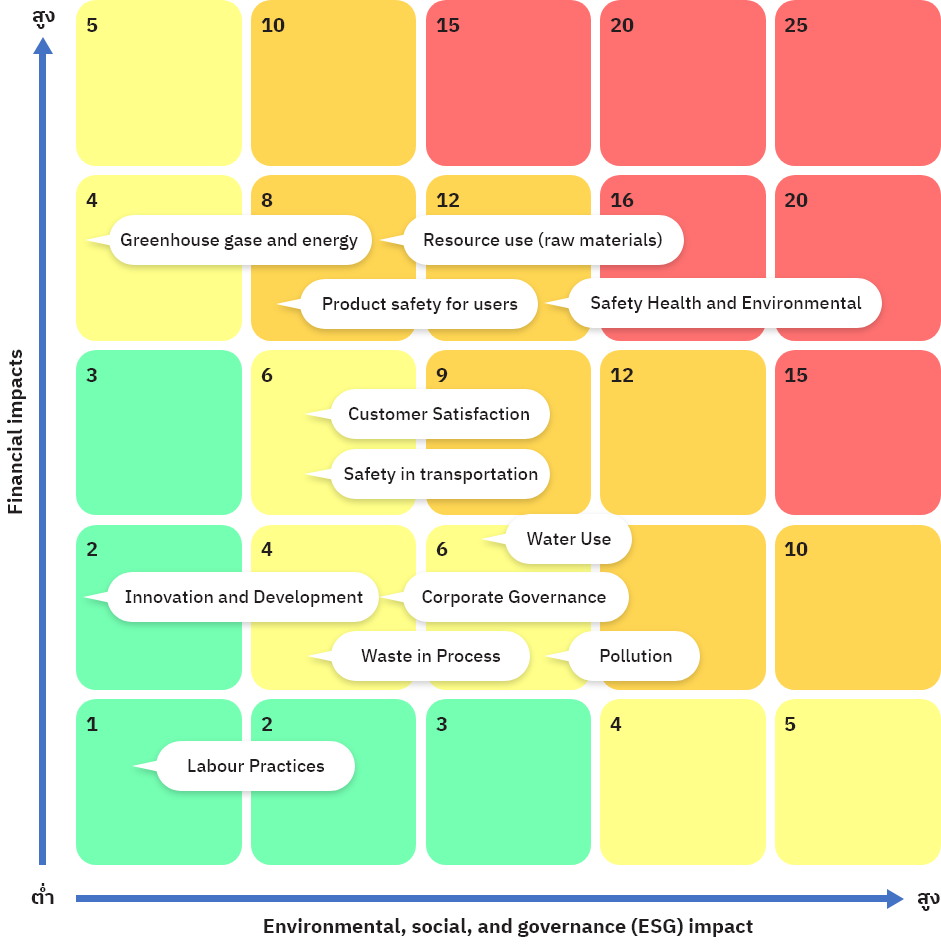
In assessing key sustainability issues for analysis, we consider both significant positive and negative impacts on the economy, society, and the environment (ESG), as well as human rights aspects that have occurred or may occur in the future. This evaluation informs the reporting content, which will be reviewed annually through the following procedures:
- Review the organizational context, encompassing the supply chain from the core business activities.
- Identify key sustainability issues impacting stakeholders, including human rights, in the supply chain that affect the economy, society, and environment for assessment of their significance.
- Evaluate and prioritize key issues based on likelihood, impact magnitude, and remediation. The company uses a Double Materiality approach to assess ESG and financial impacts.
- Review the significance of key issues and report them to the board or executive management for approval and guidance on stakeholder concerns. Monitor the most significant impacts accordingly.
Safety Health
and
Environmental
Resource use
(raw materials)
Product safety
for users
Waste in
Process
Water Use
Innovation and
Development
Greenhouse
gases and energy
Customer
Satisfaction
Pollution
Corporate
Governance
Safety in
transportation
Labour
Practices

Environmental
The Company is committed to continuously improving its environmental performance by increasing green spaces, enhancing landscape quality, reducing pollution-generating activities, and optimizing operations to lower carbon emissions. The Company operates under its “Green Model Policy,” which covers six key areas, and systematically prepares greenhouse gas emission reports to support its path toward carbon neutrality in the future.
In 2025, the Company obtained Carbon Footprint for Organization (CFO) certification covering Scope 1, 2, and 3 emissions, demonstrating its commitment to transparency and environmental responsibility. This supports effective greenhouse gas management and the Company’s long-term sustainable growth.


Social
The company is committed to developing human resources to gain a competitive edge by enhancing efficiency and fostering innovation. We prioritize the safety and occupational health of our employees and all stakeholders, believing that a positive work environment boosts performance. A safety management system is in place to ensure compliance with legal and international safety and health standards.

Corporate Governance
The company prioritizes good governance and business ethics, reflecting an efficient and transparent management system that builds trust among shareholders, investors, and stakeholders. The board, management, and all employees adhere to governance policies and promote ethical practices at all levels, ensuring strict compliance

Economic
Salee Colour Public Company Limited and its subsidiaries operate with good governance, considering all stakeholders to promote sustainable and profitable growth. The company implements a risk management system to address both short-term and long-term economic opportunities, ensuring stakeholder confidence.
Reporting
Salee Colour Public Company Limited has prepared a sustainability report to disclose its performance in sustainability and communicate key issues to stakeholders. The report covers strategies and performance across three dimensions: economic governance, social responsibility, and environmental impact. Developed in accordance with Global Reporting Initiative (GRI) standards, it presents annual performance data for the company's operations in Thailand
Awards






“We believe that everyone has a part to play in the future of this world.”
MONICA is a brand founded on the principles of Circular Economy, emphasizing the efficient use of resources alongside business operations. As a manufacturer in the plastics industry, we are dedicated to developing products that contribute to environmental preservation and responsibly caring for ecosystems for future generations.