


- About Us

- Products
- Services
- Investor Relations
- News & CSR
- Blog
- Sustainability
- Distributors
- Contact Us
- Notice / Finance Policy
- Privacy Notice
- e-Billing System
- Intranet
Supply Chain Management

Salee Colour's core business value chain
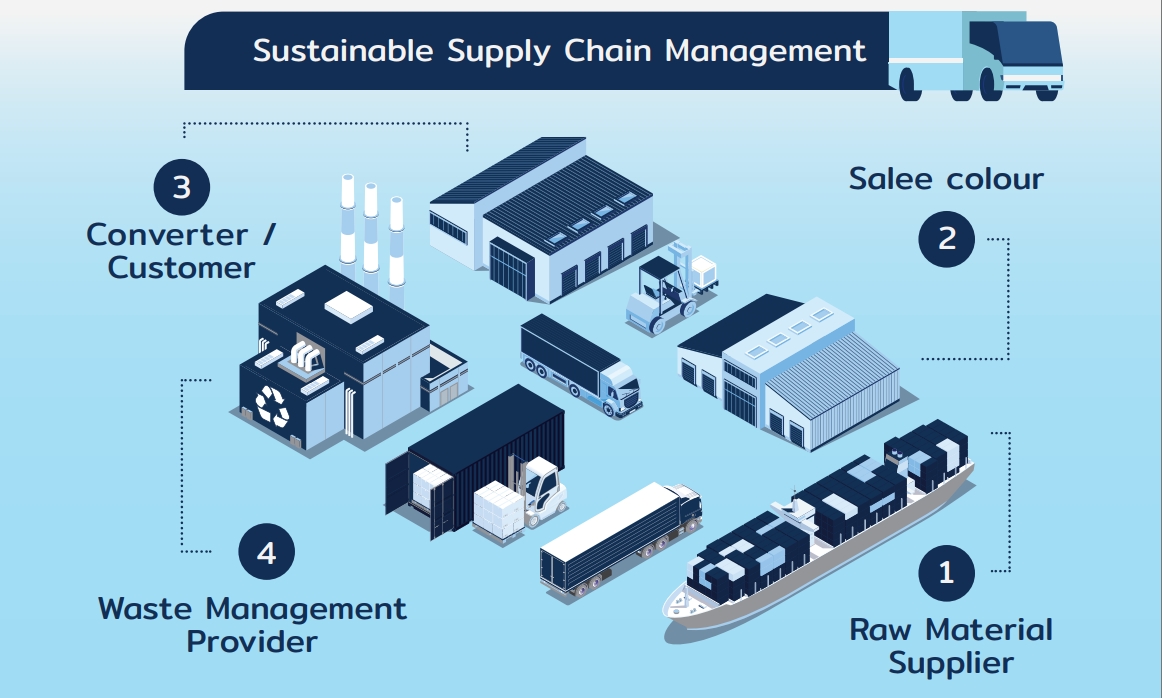
The Company is dedicated to sustainable business practices across its value chain, aligning with its strategy to consider all stakeholders. By actively listening to feedback for continuous improvement, the Company aims to create sustainable value and minimize negative impacts, ultimately delivering optimal value to stakeholders. A summary of the transition from the old approach to the new sustainable supply chain management strategy has been developed based on past operations.
Target
Build a Sustainable Supply Chain
SDGs Targets

Management Approach
The Company is committed to responsible supplier and partner relationship management by integrating economic, social, and environmental considerations to strengthen its value chain and support sustainable growth.
Supplier selection is conducted transparently and fairly, with emphasis on legal compliance, human rights, and adherence to international standards such as ISO 9001, ISO 14001, and ISO 45001. Supplier performance is also regularly evaluated based on ESG criteria.
In addition, the Company collaborates with suppliers to develop environmentally friendly processes and products, while continuously improving practices to enhance transparency, trust, and long-term sustainability.
Sustainable Supplier Management Performance
Supplier Evaluation
- Ensure compliance with the Company’s quality and service standards
- Improve processes and enhance delivery performance in line with requirements
- Adopt technologies to increase operational speed and accuracy
- Develop online systems (Intranet) for real-time inventory management and order tracking
- Encourage and support suppliers to align with ESG-based business practices
Supplier Engagement and Relationship Management
- Establish policies and guidelines for suppliers to ensure fair, transparent, and equitable business practices, while supporting partners aligned with sustainability principles
- Maintain continuous communication to align shared sustainability goals between the Company and suppliers
- Monitor and evaluate supplier performance through questionnaires, document reviews, and ESG-based assessments
- Manage supply chain risks by assessing supplier capabilities and procurement processes to mitigate environmental, social, and governance risks
Transportation
- Ensure strict safety standards and conduct rigorous monitoring of transportation personnel
- Control delivery operations to meet defined performance criteria
- Develop online inventory systems for real-time tracking by partners
- No major transportation-related accidents reported
Summary of performance in other areas of the supply chain
Percentage of new suppliers screened using environmental criteria:
100%
Percentage of local suppliers (Supplier / Service / Outsource):
14.21%
Planned onsite supplier audits:
3 suppliers
100%
of suppliers have achieved Green Industry Level 2 or higher
100%
of key suppliers, contractors, and business partners were screened for human rights compliance
100%
of suppliers were evaluated in 2025, totaling 269 entities
Percentage of suppliers acknowledging business ethics:
85.41%
New suppliers were evaluated across economic, social, environmental, and human rights criteria,
totaling 37 suppliers.
