


- About Us

- Products
- Services
- Investor Relations
- News & CSR
- Blog
- Sustainability
- Distributors
- Contact Us
- Notice / Finance Policy
- Privacy Notice
- e-Billing System
- Intranet
Occupational Health and Safety Management

Targets
- Reduce Lost Time Injury Frequency Rate (LTIFR)
- Achieve zero fatality rate from workplace injuries
- Maintain Occupational Illness Frequency Rate (OIFR) at zero
- No significant oil or chemical spills to the environment
SDGs Targets
The Company places the highest priority on occupational health and safety, recognizing that workplace accidents may impact employees, assets, and overall business operations.
A clear safety policy has been established, requiring executives, employees, and contractors to share responsibility for their own safety and that of others, in accordance with ISO 45001 standards and relevant regulations.
The Company has implemented a structured safety management system, supported by dedicated committees responsible for oversight. Regular monitoring activities are conducted, including site inspections and monthly safety committee meetings to track performance and ensure timely corrective actions.

Management Approach and Operations
The Company is committed to providing a safe and healthy working environment for all employees by operating in accordance with international standards and legal requirements, while fostering a proactive safety culture across all levels.
A clear Occupational Health, Safety, and Environmental (OHSE) policy has been established and communicated to employees and stakeholders, supported by regular risk assessments to implement appropriate preventive and control measures.
Operationally, the Company conducts safety training, incident investigations, and performance monitoring through key indicators such as injury rates, with reporting aligned with international standards. Safety management is implemented in accordance with ISO 45001, alongside continuous awareness programs.
A Safety, Health, and Environment Committee, including employee representatives, has been established to oversee and monitor performance. Employees and contractors are encouraged to participate through initiatives such as safety talks and internal communication programs.
This approach reflects the Company’s commitment to reducing risks, preventing accidents, and maintaining a safe and sustainable workplace.
Occupational Health and Safety Training
The Company provides occupational health and safety training for all employees and contractors prior to commencing work, based on job roles and risk levels. In 2025, key training programs included:
- Safe driving skills for motorcycle users
- Electrical safety awareness
- Safety management personnel training (TSM) and national safety programs
- Accident-free workplace initiatives
- Supervisor-level safety officer training
- Chemical spill preparedness and response
- Fire evacuation drills - Basic firefighting training
- Safety refresher training for cranes and forklifts
Performance Result
100% of employees
received safety training
Working Committee
The Company has not established a labor union. However, to ensure structured operations and effective implementation of internal activities, working committees have been established to support initiatives and promote organizational culture in line with planned objectives.
The Company has appointed three committees through an election process:
- Safety Committee (OHS Committee)
- Welfare Committee
- 5S Committee
Each committee serves a two-year term, with representatives selected from various departments to encourage continuous employee participation. Management serves as advisors to provide guidance, while employees are encouraged to share feedback to support ongoing improvement. For more details, please visit: https://www.saleecolour.com/th/sustainability-report
Occupational Health and Safety Risk Assessment
The Company places strong importance on providing a safe and suitable working environment by continuously conducting occupational health and safety risk assessments. These efforts aim to prevent workplace accidents and occupational illnesses, while ensuring that all employees operate under safe and compliant conditions.
Operational Approach
- Conduct hazard identification and risk assessments, with control measures implemented to reduce risks to an acceptable level
- Review risk assessments at least annually to ensure the effectiveness of control measures
- Conduct Safety Talks before work to communicate safety requirements and check readiness
- Hold regular monitoring meetings every Tuesday to ensure operational compliance
- Require each department to assess risks in their areas at least once per year
- Continuously review data and improve measures to align with changing conditions
Risk Assessment Results in 2025
Risk assessment identified key risk activities, including material ejection during operations, machinery operation, and vehicle collisions, which require close monitoring and control. The Company has implemented appropriate measures to prevent incidents and mitigate risks effectively.
Preventive and Control Measures
- Inspect and assess safety equipment, such as fire extinguishers, to ensure readiness
- Enforce the use of personal protective equipment (PPE) in accordance with job requirements
- Provide continuous safety training and awareness programs for employees
- Conduct incident investigations by safety officers to prevent recurrence
- Improve workplace conditions to enhance safety
- Perform regular monitoring and review to ensure effectiveness
Ongoing project
Project : Safety Talk
Project Description
The Company conducts Safety Talk sessions prior to commencing work under the KYT (Kiken Yochi Training) safety program for all departments, employees, and contractors. These sessions aim to ensure proper work practices, shared understanding, and awareness of safety procedures, including equipment operation (e.g., forklifts) and updates on safety performance statistics.
Benefits of the Project
- Builds team relationships and fosters creativity
- Reinforces correct work procedures step by step
- Encourages a strong safety mindset
- Enhances communication and collaboration between employees and safety personnel Promotes shared learning and continuous improvement
Company Benefits from Employee Development
- Improves operational efficiency and reduces costs, enhancing business competitiveness
- Develops a more capable and high-potential workforce
- Fosters a culture of communication and safety awareness
- Reduces risks and losses from workplace accidents
- Promotes teamwork and creates a positive and productive working environment
Occupational safety, health and environment operations in 2025
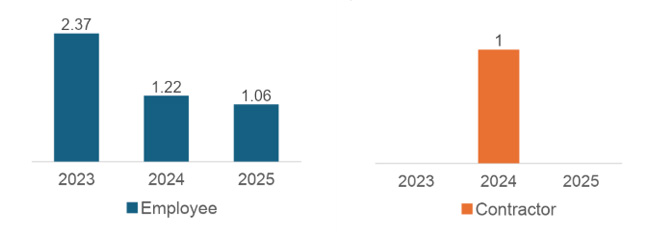
Total Work Injury Rate Statistics:
TRIR (cases/200,000 working hours)
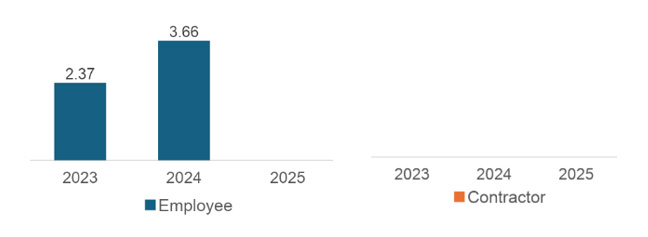
Lost Time Injury Rate Statistics:
LTIFR (cases/200,000 working hours)
Occupational Illness Frequency Rate Statistics:
OIFR (cases/200,000 working hours)
Temperature, Lighting, and Noise Levels
Heat:
9 monitoring points
Result: Passed
Lighting:
2211 monitoring points
Result: Passed
Noise:
10 monitoring points:
Result Passed
